I'm Making My Dev Team Work on Thanksgiving
2 scrum-style AI agent pods now build a client's operating system around the clock for about $500 a month. Here's how, and what owners who never write code can copy.
In October, 4 pull requests were opened on a client's AI operating system between 10pm and 6am. In November, 49. I was asleep for most of them.
Tomorrow is Thanksgiving. I'll be at the table with my family. My dev team won't be.
I built that system to run the back office for a design-build remodeler I work with: pipeline, estimates, scheduling, field work and books. A month ago, nearly every change to it started with me at a keyboard, steering 3 or 4 Claude Code sessions at once. Today it's built by 2 full-stack teams of AI agents that pick up work on their own, review each other's work, and ship every morning before the crews head out.
Here's what changed, how it maps to scrum, and what an owner who will never write code can take from it.
The old way: me as the bottleneck
From August through October, my setup looked like most people's. I'd open a few Claude Code sessions, give each one a task, and bounce between them. Answer a question here, approve a plan there, review a diff, merge, repeat.
It worked. We merged about 45 pull requests a week. But every one of them went through me. When I was in client meetings, the work stopped. At night, it stopped. On weekends, it mostly stopped.
The AI wasn't the constraint. I was.
The new way: 2 pods and a platform team
On Oct 23 I handed the day-to-day to an unattended team. Two days later I reorganized it into pods.
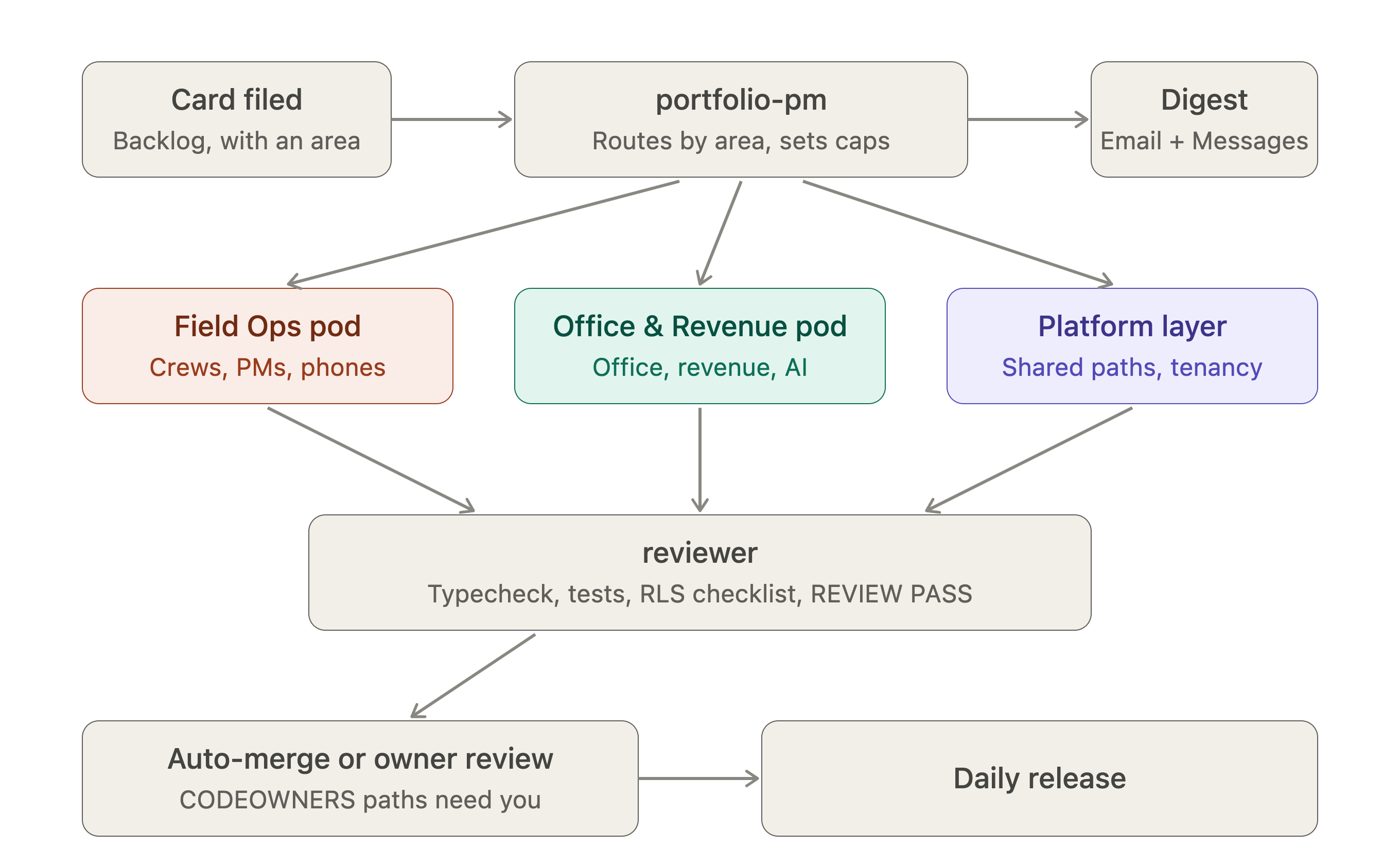
There are 2 pods, split by the part of the business they serve, not by tech layer. Each one is full stack: it owns a feature from the database to the screen.
- Field Ops: scheduling, builds, QC, dispatch and the field app. Its users are crews and project managers on phones.
- Office & Revenue: pipeline, inbox, estimates, books, KPIs and marketing. Its users are office staff and management.
Each pod has a product manager, a dev lead, 2 developers, a UX designer and a QA engineer. Under both sits a platform layer: a portfolio PM that routes work, a CTO that writes architecture recommendations, a security reviewer with veto power, a platform engineer, and a final reviewer. That's 17 roles. Every one is an AI agent with a written job description.
A card doesn't get all 17. The dev lead's plan has to list the roles the card needs, and only those get called. A button fix gets a developer, UX and QA. A change that touches money or logins gets security too.
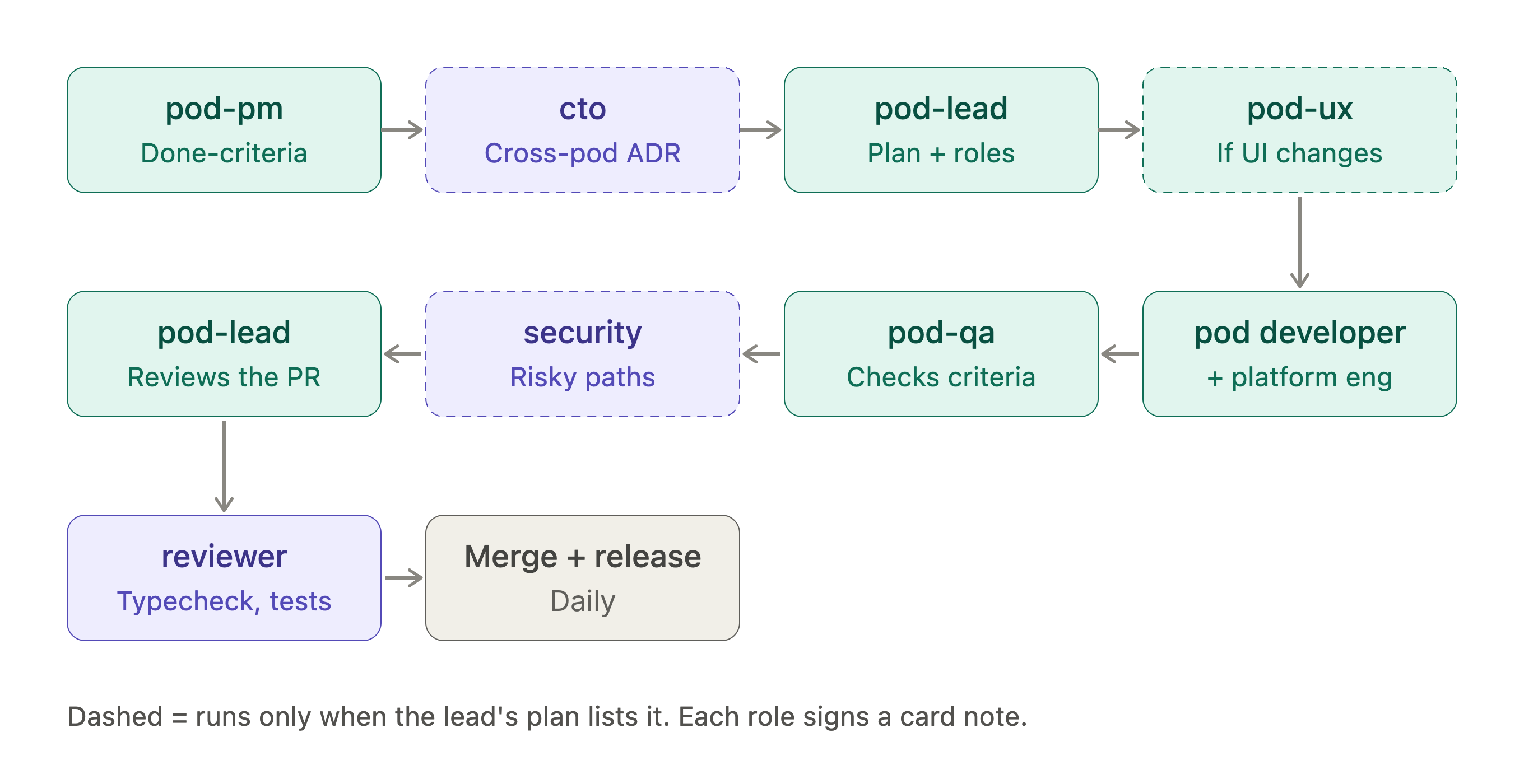
The loop runs around the clock. Every hour, a developer session claims the next ready card. Every morning, whatever passed the gates ships to production. Right after that, the PM triages the board, unsticks stalled work and sends me a digest.
The numbers
- Throughput: about 45 merged PRs a week in early October. 75, 105 and 85 in the first 3 weeks of November. Roughly double.
- Hours: in October, 27 PRs were opened outside weekday business hours. In November, 138. That's about half of all the work.
- Tests: the test suite grew from 5,332 tests to 9,491 in 3 weeks. Nobody asked for that. The QA agents write tests because their job description says nothing ships without them.
- Cost: $100 a month for Claude Max. Hosting, the database, GitHub and the rest bring it to about $500 a month all in.
The surprise: the constraint isn't money. It's the weekly usage limit on my Claude plan. Two weeks in, the pods were burning through it so fast that I capped them at 43 cards a week. I went from not having enough developers to rationing them, on a $100 plan.
How this maps to scrum
I didn't invent this. I borrowed scrum and gave each role to an agent.
- Product owner: me. I set priorities, and only a person can promote a card into the working backlog. Agents can suggest cards, including the voice agent that turns my spoken feedback into cards, but they can't promote their own.
- Product backlog: the system's own backlog board. Every piece of work is a card with an ID, a priority and an area. The area decides which pod gets it.
- Scrum master: the PM loop. It clears blockers, sends a fixer to stalled PRs, and tells me what's waiting on me.
- Sprint: shrunk to a day. The morning release is the increment.
- Daily standup: the PM digest, posted to the team chat inside the system so the client's team can see what's coming.
- Definition of done: written as rules a machine can check. A PR merges itself only when CI is green, the reviewer has passed that exact commit, UX has passed it if it changes the screen, it's under 400 lines, and it doesn't touch protected code.
- WIP limits: caps on cards claimed per day and per week, and on open PRs.
- Review and retro: a Friday pod sync, plus audits spread across the week. UX on Monday, security on Wednesday, AI spend on Friday.
Scrum works for people because it makes the work visible and the handoffs explicit. Agents need that even more. They don't remember yesterday unless it's written down, and they don't stop to ask unless a rule tells them to.
What still needs a human
Plenty, on purpose.
Anything that touches money, logins, security or the database schema needs my review. Cards that add new tables wait for me. The CTO agent recommends and I decide. Production releases run on a fixed schedule, behind a gate that refuses to ship a broken build.
It also breaks. One night in November the sessions hit a usage limit around 11pm and sat idle until I woke up and typed "try again." Most of the night was lost. Now the coordinator reads the reset time and restarts them on its own.
That's the job now. Less doing the work, more fixing the system that does it.
What this means if you don't write code
You probably don't have a software team. You do have a back office: estimates, scheduling, invoices, follow-ups. The same pattern applies.
- Write the job description first. In January 2025, Jensen Huang said IT departments would become the HR department of AI agents. In a small business, that's the owner. Each agent on my team works because its role is written down: what it owns, what it checks, when it stops. Vague roles get vague work.
- Define done as a checklist. If a person has to judge whether something is done, it waits for that person. If a checklist can judge it, it ships.
- Guard the doors that don't reopen. Money, customer messages, contracts. Keep a human on those and let the rest run.
- Cap the work in progress. Agents will happily start 40 things at once. Limits keep it to what you can absorb.
- The backlog is the product. The clearest card wins. Your job moves from doing the work to deciding what's next.
If you're planning 2027 right now, the question isn't whether to use AI. It's whether you're still the person every task has to pass through.
That's what I build at Massively Useful: custom AI operating systems for owner-led businesses under $20M, so the business keeps running when you step away.