


Why Every $2M Owner Should Learn to Vibe Code (And Why Most Will Fail At It)
Two things are true at the same time right now, and almost every article about AI coding tools picks one and ignores the other.
The first is that the case for a $2M business owner learning to build software with AI is now overwhelming. Not "interesting." Not "worth watching." Overwhelming. The leverage is real, the cost has collapsed, and the floor of what a non-developer can build has risen faster in the last eighteen months than in the previous twenty years combined.
The second is that most owners who try will fail at it. Not because the tools are too hard. Because the thing that makes a build succeed isn't the typing, and the typing is the only part the AI made cheap.
This post is about both claims, because you can't make a good decision with only one of them. If you read the bullish case and skip the failure modes, you become one of the failure modes. So here is the honest version of where this works, where it falls apart, and what separates the owners who get leverage out of it from the ones who quit in six weeks.
The bullish case is not hype anymore
Start with adoption, because the numbers have crossed the line from "early" to "default" faster than most owners realize.
In Stack Overflow's 2025 developer survey, 84% of developers reported using or planning to use AI tools in their workflow, with a majority now using them daily. That's the professionals. The more interesting number is on the other side of the fence: depending on the survey, roughly 63% of "vibe coding" users are not developers at all. They're founders, operators, analysts, and owners building user interfaces, internal tools, and small full-stack applications without a traditional engineering background. Gartner projects that 90% of enterprise software engineers will use AI code assistants by 2028, up from under 14% in early 2024. The vibe coding market itself is estimated at around $4.7B in 2026.
This is not a fad cycle. This is a tool category becoming infrastructure.
For a $2M owner, the relevant part isn't the macro trend. It's what the trend makes possible at your scale. A year ago, if you wanted a custom dashboard that joined your CRM data to your accounting data to your ad spend, you hired a developer for $15K or you bought a $30K analytics package or you didn't get it. Today you can build a usable version of it yourself, in evenings, with a tool like Claude Code doing the parts that used to require a computer science degree. The economics we wrote about in The Data Moat Just Collapsed and in the CRM unbundling post aren't theoretical. They're available to any owner willing to learn to steer the tools.
That's the case. The owner who learns this gets a permanent reduction in the cost of answering their own questions and building their own tools. In a business where most of the friction is "I can't see X" or "I wish the system did Y," that's a structural advantage. Every owner should at least try, because the downside of trying is a few weekends and the upside is a capability that compounds for the rest of the time they run the business.
What "learning to vibe code" actually buys a $2M owner
Be concrete about this, because the word "vibe code" makes people imagine building the next SaaS startup. That's not the play for an operator. The play is internal leverage.
The things a $2M owner can realistically build, and should: a dashboard that answers the three questions you currently wait until month-end to answer. A small tool that automates the data entry your office manager does by hand every Friday. A script that pulls your jobs from one system and your invoices from another and tells you gross margin by job type, which your CRM has never once shown you. A lead-scoring helper. A customer-history view that joins the five places a customer currently lives in your stack. None of these are products. All of them are leverage.
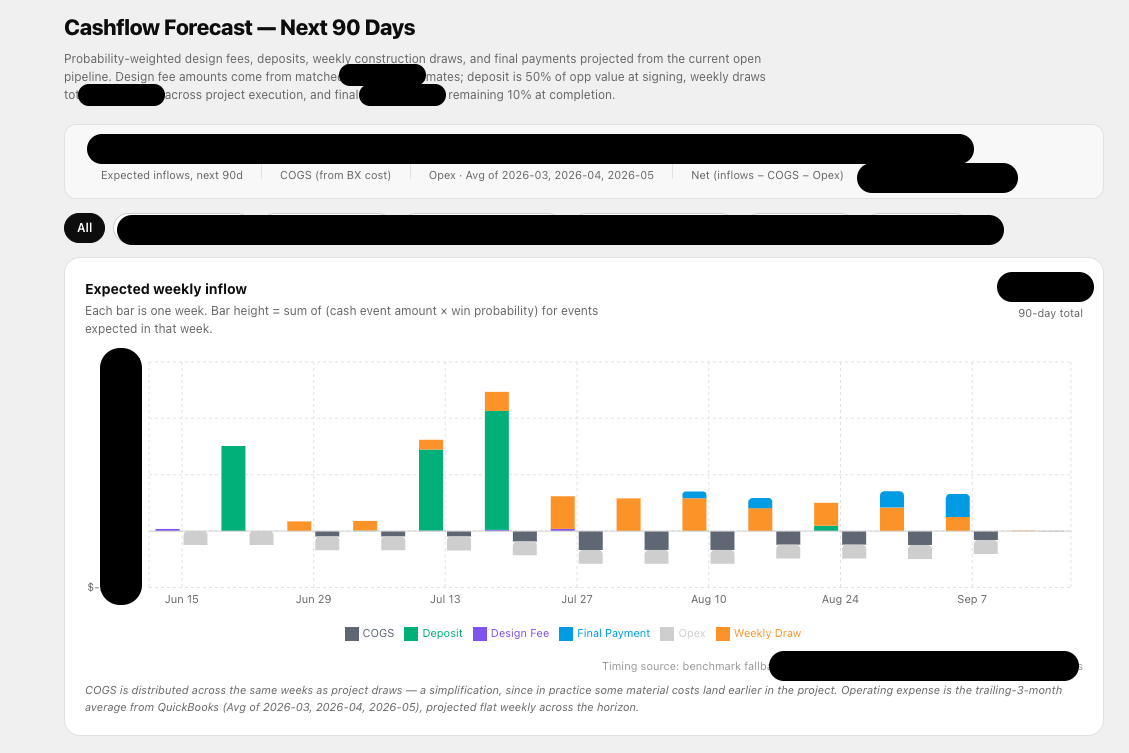
I do this work for a living, and the clearest proof point I have is the Black River build. Black River Design and Build is a Wisconsin design-build remodeler we work with publicly, the one whose pipeline grew 150% year over year after we put a Repeatable Revenue Engine in place. Over the last few months I've been building a thin custom data layer underneath their CRM: a warehouse, a set of ingestion connectors, a semantic layer, a dashboard, and a chat interface that lets the owner ask questions of their own business in plain English. Working with Claude Code at every step collapsed the tedious parts of that build, the connectors and the schema glue and the dashboard scaffolding, into a fraction of the time they used to take.
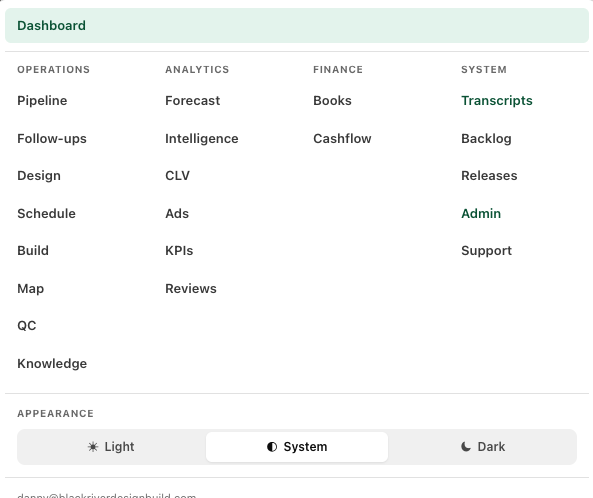
But notice what actually made that build work, because it's the whole argument of this post. The AI made the typing cheap. It did not make the judgment cheap. Deciding what to measure, how to reconcile a customer in the CRM with the same customer in QuickBooks, what "gross margin per job" should even mean for this specific business: that was the work, and none of it was typing. I could supervise the agent at that layer only because I already knew the business cold. The owner who wants this leverage has the same advantage I do, and a bigger one: nobody knows their business better than they do. That's exactly why they should learn to steer the tools. And it's also, paradoxically, why most of them won't make it.
Why most owners will fail at it
The failure mode is not capability. It's discipline and judgment under load. Here is what that actually looks like.
Start with the single most important statistic in this entire space. In the same Stack Overflow survey where adoption hit record highs, the number one frustration developers reported, cited by 66% of them, was dealing with AI solutions that are "almost right, but not quite". Trust in AI output actually fell, with only 29% of developers saying they trust it, down eleven points from the year before. Read that carefully. The professionals, the people who can read the code, find that the hardest part of the job is catching the answer that looks correct and isn't. Now hand that same problem to an owner who can't read the code at all.
"Almost right but not quite" is a manageable problem if you can verify the output. It is a catastrophic problem if you can't. And verification is precisely the muscle a non-developer hasn't built. The AI will generate something that runs, passes the one test the owner thinks to try, and looks finished. Whether it's actually correct, secure, and safe to run on real customer data is a separate question the owner has no way to answer.
This is not a hypothetical risk. It's a 2026 headline. Security audits this year found that roughly 45% of AI-generated code contained high-risk security flaws, and other research put AI-coauthored code at 2.74 times the security-vulnerability rate of human-written code, with misconfigurations 75% more common. The real-world incidents read like a warning label. CVE entries attributed to AI-generated code jumped from 6 in January 2026 to more than 35 by March. One vibe-coded app, Moltbook, exposed 1.5 million API keys because it shipped without row-level security. A platform called Base44 had an authentication bypass that endangered every app built on it. Even Amazon, with all its engineering rigor, logged four severity-one production incidents in 90 days that internal documents tied to gen-AI-assisted changes.
The thread connecting almost every one of these failures is the same, and it's the thread that should worry an owner most: the part everyone skipped was verification. The AI generated functional code that passed every manual check the builder ran. There were no automated tests, no governance constraints, no second set of eyes. It worked in the demo and broke in production. That's not a tooling failure. That's a discipline failure, and discipline is exactly what's hardest to sustain when you're a tired owner trying to ship a thing at 10pm after a full day in the business.
There's a quieter failure mode too, and it's the one that takes out the most people. Most owners who start learning to build with AI in 2026 will quit within about six weeks, for the same reason most people quit the gym in February. The first weekend is electric. You build something that would have cost you thousands, and it feels like a superpower. Then the second project is messier. The third one breaks in a way you can't diagnose. The novelty wears off, the real work of building judgment sets in, and the owner who came for the magic trick leaves before they develop the skill. The tool didn't fail them. The expectation did.
What separates the owners who actually stick
Across the operators I've watched succeed at this, and the case studies of citizen developers who built something durable, the common factors have almost nothing to do with technical talent. They have to do with how the person relates to the tool.
They treat the AI as a junior employee, not an oracle. They assume the output is "almost right but not quite" until proven otherwise, and they build a verification habit around it: a test, a sanity check, a careful read of what the thing actually does before it touches real data. They never let code they don't understand run against their customers.
They start with low-stakes internal tools and earn their way up. The owner who survives this doesn't begin by rebuilding the system the business depends on. They begin with a dashboard nobody but them looks at, where a bug costs them an evening and not a customer. They build judgment on projects where failure is cheap, and only graduate to load-bearing systems once they've felt the tool be confidently wrong a few times.
They know their own business cold and they lean on that, hard. This is the owner's real edge over a hired developer, and the ones who stick understand it. The AI doesn't know what "gross margin per job" means for your business, what a good lead looks like in your market, or which of your five customer records is the real one. You do. The successful owner supervises the agent at the layer of business judgment, which is the layer that's still expensive and still scarce, and lets the agent handle the layer that's now cheap.
They put guardrails in before they need them. Row-level security, a staging environment, automated tests on anything that touches money or customer data, secrets kept out of the code. The owners who get burned are the ones who add governance after the incident. The ones who stick add it before, because they read the headlines and believed them.
And they're honest with themselves about whether they have the time. This is the one nobody likes. Learning to steer these tools well is a real skill that takes real reps, and an owner who is genuinely in the truck 55 hours a week may not have the hours to build it. For that owner, the right move often isn't to learn to vibe code. It's to find a partner who already has, and who knows the business well enough to supervise the build on their behalf. That's not a failure. That's judgment.
The honest bottom line
Should every $2M owner learn to vibe code? Yes, in the sense that every owner should at least try, because the leverage is real, the floor has risen, and the cost of trying is a few weekends against an upside that compounds for years.
Will most of them succeed? No. Not because the tools are too hard, but because the tools made the easy part cheap and left the hard part, which is judgment, verification, and discipline under load, exactly where it always was. The owner who confuses the cheap part for the whole job becomes a statistic in next year's security audit.
The split between the two outcomes isn't talent. It's how seriously the owner takes the part the AI didn't solve. The ones who treat the agent as a junior employee they have to supervise, who start small, who verify everything, who lean on the business knowledge nobody else has, and who put guardrails up before the incident, get a durable advantage. The ones who treat the agent as a magic trick get a demo that works and a production system that doesn't.
If you recognize yourself in the first group, this is the best moment in the history of small business to learn to build. If you recognize yourself in the second, the most valuable thing you can do is recognize it now, before the bad code is load-bearing.
Either way, the question worth answering isn't "can I build this." In 2026, you almost certainly can. The question is "can I tell when it's wrong." That's the whole game.
This is the capstone in a four-week series on the new economics of SMB data and software, following The Data Moat Just Collapsed and the CRM unbundling post. If you want help figuring out which parts of your stack you should build, which you should buy, and who should supervise the build, start with a Revenue Audit at massivelyuseful.ai.
