


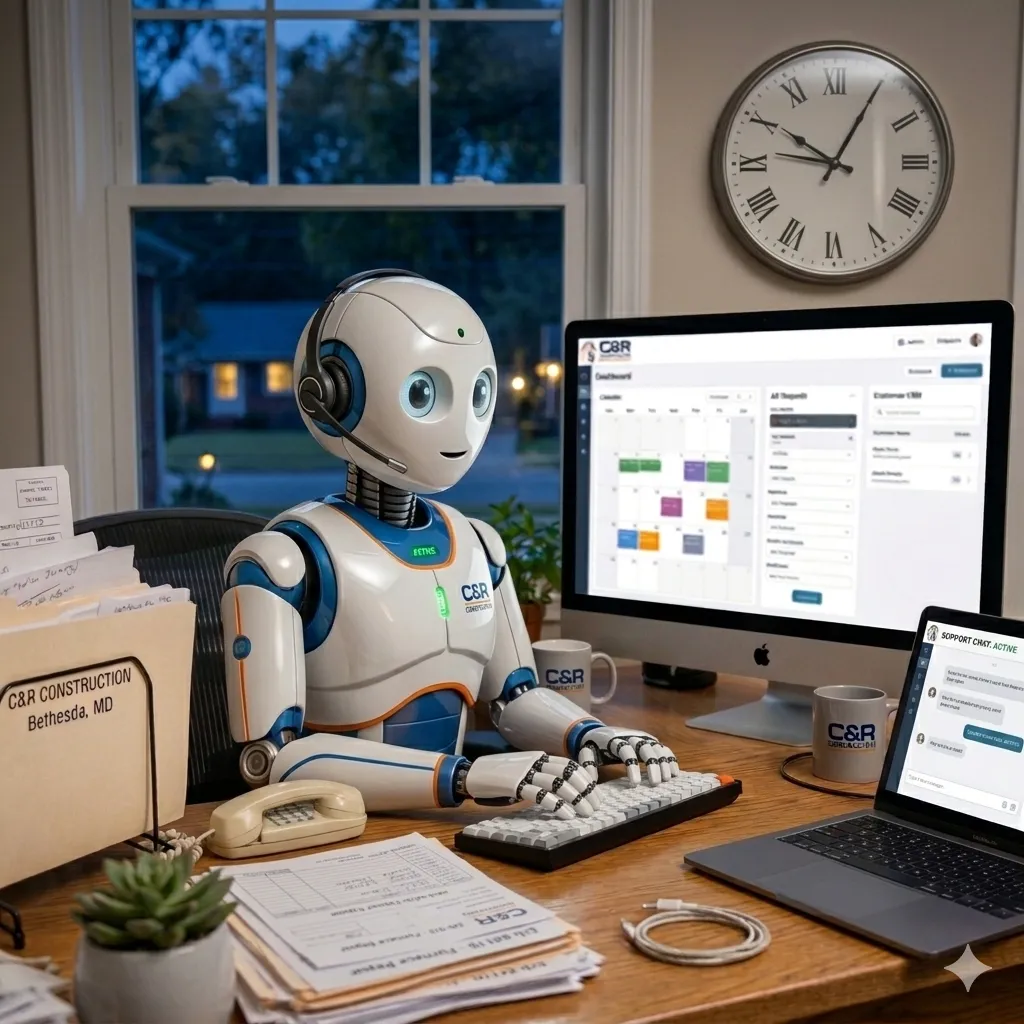
Stop Losing Leads at 9 PM: How AI-Powered Automation Helps Home Service Contractors Win More Jobs
You finish a long day on the job, get home, and your phone has four missed calls and two web form submissions. By the time you follow up in the morning, two of those customers have already booked a competitor.
That's not a sales problem. That's a response time problem— and AI automation solves it.
For contractors and home service businesses, the window between a customer's first inquiry and their booking decision is shrinking. Research consistently shows that leads contacted within five minutes are dramatically more likely to convert than those reached an hour later. After 24 hours, most are gone.
The good news: you don't need a call center or a full-time receptionist to compete. You need the right system.
Why AI Automation Is a Fit for Home Service Businesses Right Now
The technology has finally caught up to the need. Large language models (LLMs) and conversational AI platforms have become affordable and accessible enough for small and mid-sized contractors to deploy, not just Fortune 500 companies.
At the same time, customer expectations have risen sharply. Homeowners searching for a plumber, HVAC tech, or roofer expect near-instant responses. If your website or Google Business Profile doesn't give them one, they move on.
The businesses winning in this environment aren't necessarily the biggest or the cheapest. They're thefastest and most consistent.
The Massively Useful take: Automation doesn't replace your team — it covers the hours when your team isn't available, and makes sure nothing falls through the cracks when they are.
5 Ways Contractors Are Using AI Automation to Win More Jobs
1. Instant Lead Capture and Qualification
An AI chatbot on your website or landing page can greet every visitor, ask the right qualifying questions (service needed, location, timeline, budget range), and route hot leads to your team immediately — 24 hours a day, including weekends and evenings when most leads come in.
Instead of a contact form that sends an email no one checks until morning, you get a live conversation that captures intent and books the next step.
2. Automated Appointment Booking
When a lead qualifies, AI can offer available time slots and book the appointment directly into your scheduling system — no phone tag, no back-and-forth. The right technician gets dispatched, the customer gets a confirmation, and your office staff doesn't have to touch it.
For high-volume contractors running multiple crews, this is a significant operational win.
3. Automated Follow-Up Sequences (SMS + Email)
Most leads don't convert on the first touch. A well-built automation sequence follows up with unconverted leads over several days — through SMS, email, or both — without anyone on your team having to remember to do it.
The result: leads you would have lost to inaction get a second (and third) chance to book.This alone can meaningfully lift your close ratewithout increasing your ad spend.
4. On-Demand Estimates and Proposal Delivery
AI can generate ballpark estimates or templated proposals based on the information a lead provides — delivered instantly, before a competitor even returns their call. Even a rough range keeps you in the conversation and signals responsiveness.
5. Post-Job Review and Referral Automation
Happy customers rarely leave reviews unless you ask — at exactly the right moment. Automated post-job texts and emails, timed to go out a few hours after a job closes, dramatically increase review volume and Google ranking over time.
The same workflow can trigger referral asks for customers who give you 5 stars. This is one of the highest-ROI automations for any home service business.
What to Watch Out For (The Contractor's Honest Guide)
AI automation is powerful, but it isn't magic. Here's what trips up contractors who rush into it:
Robotic messaging kills trust. If your chatbot or SMS sequences sound like a form letter, customers will disengage. Conversational tone, personalization, and clear human-handoff points are non-negotiable.
Bad qualification = bad leads. If your AI is sending every tire-kicker to your sales team, you've created a new problem. Spend time defining what a qualified lead actually looks like for your business before you build.
Integration complexity is real. Connecting AI tools to your CRM, scheduling software, and phone system takes setup. It's doable — but not plug-and-play. Plan for configuration time.
SMS compliance matters. You need proper opt-in consent before automating text messages. This isn't optional — non-compliance carries real financial risk. Work with a provider who builds this in.
Always have a human-handoff rule. When a customer is frustrated, asking a complex question, or signaling they're ready to book, your system should route them to a real person immediately. Automation should support your team, not replace their judgment at critical moments. In our experience, some customers simply dislike talking to AI, so giving them an escape hatch is critical.
Where to Start: A Practical Roadmap for Contractors
The biggest mistake service businesses make with AI automation is trying to do everything at once. Start with one high-impact, measurable workflow, run it for 30–60 days, and measure conversion before you expand.
A recommended starting sequence for most contractors:
Week 1–2: Set up an SMS auto-reply for missed calls and web form submissions. Even a simple "Thanks for reaching out — we'll call you within 2 hours" with a booking link outperforms no response.
Week 3–4: Add a basic website chatbot for after-hours lead capture and qualification.
Month 2: Build a 3-touch follow-up sequence for unconverted leads (Day 1, Day 3, Day 7).
Month 3+: Add post-job review automation, then lead scoring and routing as your volume grows.
Track your contact-to-book rate at each stage. That's your north star metric — not the number of automations you've built.
The Bottom Line for Home Service Contractors
AI-powered lead capture and automation aren't coming — they're here, they're affordable, and your competitors in your market are starting to use them. The contractors who move first get the advantage of a faster, more consistent customer experience without proportional increases in overhead.
You don't need to become a tech company. You need a system that works while you work, and follows up when you can't.
That's what we build at Massively Useful.
Ready to Build Your Revenue Engine?
A Revenue Audit is 45 minutes with one of our strategists — we map your current lead flow, find the gaps, and show you exactly which automations will move the needle first. The blueprint is yours to keep, no obligation.
45 minutes. No obligation. Blueprint is yours to keep.
