


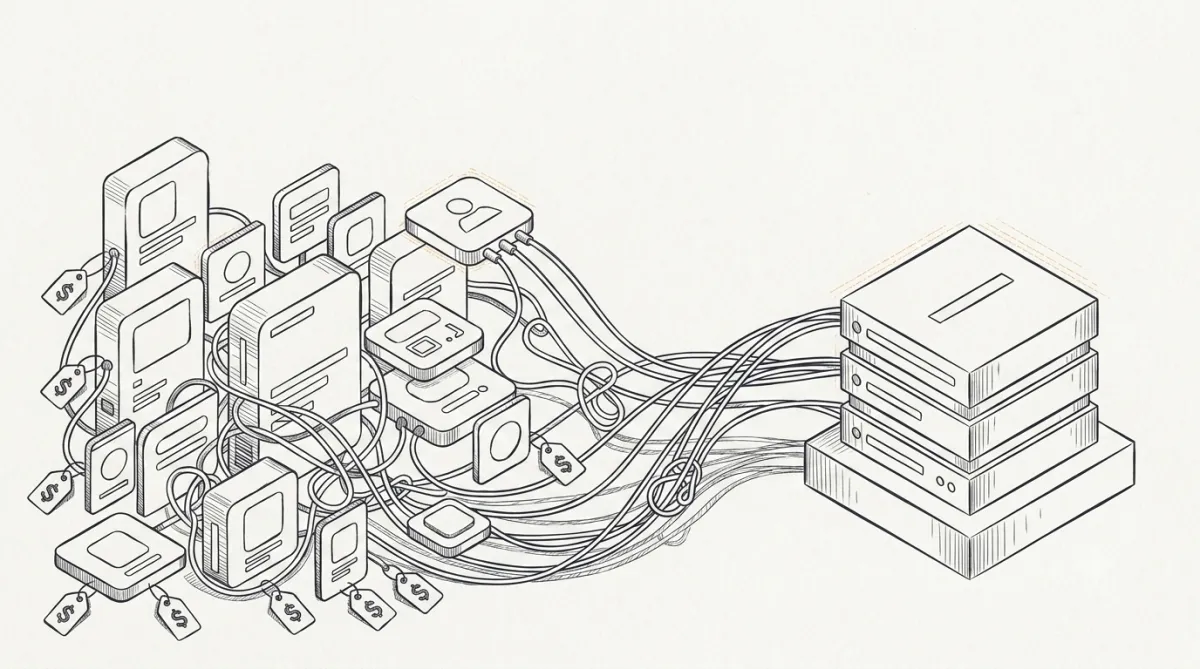
Your Contractor SaaS Stack Costs $500 a Month. Half of It Can Be Replaced for $50.
Before I make the case, let me kill the version of this post you've already read somewhere else.
There is a genre of content on LinkedIn right now that says every SaaS subscription is a scam, that you can rebuild your entire software stack over a weekend with an AI coding tool, and that anyone still paying for software is a mark. That genre is wrong, and following it will cost you more than the subscriptions ever did.
Here's the honest version. The typical $1-3M contractor is running somewhere between six and ten software subscriptions, and the total is bigger than they think. Some of those subscriptions are worth every dollar and should never be touched. Some of them are a generic database with a markup, and in 2026 you can replace them for roughly the price of two pizzas a month. The skill worth having is knowing which is which.
This post is the scorecard.
What you're actually paying, itemized
Add up a realistic stack for a $2M home service business in 2026.
The field service platform or CRM is the big one. Jobber runs $29 a month for a solo operator and climbs to $129 to $249 for a crew. Housecall Pro starts around $59 to $65 and its popular mid tier lands near $149. If you're on ServiceTitan, you're in a different weight class entirely: pricing isn't public, but industry reporting puts it at roughly $245 to $500 per technician per month, which means a 15-tech HVAC company is paying somewhere between $44,000 and $90,000 a year before a mandatory onboarding fee of $1,000 to $5,000.
Then accounting. QuickBooks Online now runs $38 a month for Simple Start, $75 for Essentials, and $115 for Plus, after Intuit raised prices 15 to 20% across the board. Add payroll and it climbs fast: QuickBooks Payroll Core is about $50 a month plus $6.50 per employee, so a ten-person shop is adding roughly $110 a month just to pay its people.
Then the rest of the sprawl: an estimating tool, an email and SMS marketing platform, a review management tool, maybe a standalone scheduler, a form builder, a call tracking service, and the higher-tier add-on you bought from your CRM to unlock reporting it should have included in the first place.
Call it $400 to $800 a month for a well-run small shop, and well into four figures if you're on ServiceTitan or paying for a lot of seats. That's $5,000 to $15,000 a year, and most owners have never once sat down and listed it out.
Now here's the part that matters. That number is not the problem. The problem is that a meaningful chunk of it is buying you something that stopped being expensive to build.
The three layers, and why only one of them is still worth what you pay
Take any of these tools apart and you find the same three layers stacked on top of each other, the same ones we described in the CRM unbundling post.
There's the database. Rows and columns: customers, jobs, invoices, leads, communications. Every tool has one, and in 2026 it is the cheapest part of the stack. Supabase Pro gives you a production-grade Postgres database for $25 a month, with headroom a contractor doing $3M in revenue will never come close to exhausting.
There's the interface. Dashboards, reports, forms, views. Some of it is genuinely good and expensive to replicate. A lot of it is mediocre, was expensive to build five years ago, and can now be built in days with an AI coding tool.
And there's the opinions. The actual product: the workflow ServiceTitan thinks a service business should run, the dispatch model Housecall Pro has refined over a decade, the compliance logic Intuit maintains as tax law changes every year. This is the compounded learning you are really renting, and it is the only layer that still justifies a real subscription.
The reason your stack costs what it costs is that these three layers are bundled. That bundling made sense when all three were expensive. Two of them aren't anymore. So the question stops being "should I dump my software" and becomes "which of my subscriptions am I paying a premium for because the database and the interface used to be hard?"
The replace list
Here is what a thin custom stack genuinely does better and cheaper for a contractor in 2026.
Cross-system reporting. The single biggest one. Your CRM knows about jobs. QuickBooks knows about money. Your ad platforms know about spend. None of them talk to each other, so nobody in the business can answer "what's my gross margin by job type" or "what's my true cost per acquired customer by channel" without a hand-built spreadsheet at month-end. Most CRMs will sell you a higher tier or a reporting add-on to partially solve this, for $100 to $500 a month, and it still won't cross system boundaries. A Supabase warehouse that ingests all three sources and a dashboard on top of it solves it properly, for $25.
Ad-hoc question answering. Being able to ask, in plain English, "how did close rates on Google Ads leads compare to referrals last quarter" and get a real answer from your own data. No contractor CRM does this well. A Claude API chat interface sitting on the same warehouse costs roughly $20 to $60 a month in usage at this scale and answers questions the platform was never built to handle.
Custom workflow automation. The conditional logic that crosses systems: when a job closes above a certain value, pull the margin data, segment the customer, and trigger the right follow-up. This is either locked behind your CRM's top tier or duct-taped together in a no-code tool that breaks quietly. Cloudflare Workers runs it for about $5 a month.
Lead scoring. Ranking your inbound leads against your own historical conversion data. Your CRM was never going to build this for your specific business. It's a weekend project now.
The duplicate point tools. The form builder, the standalone scheduler, the spreadsheet that somebody maintains by hand. These accumulate silently and each one is $20 to $50 a month.
Add up the thin stack that replaces all of that. Supabase at $25, Cloudflare at $5, Claude API at $20 to $60, and free tiers of Resend for email and Sentry for error monitoring at the volumes a contractor runs. That's a real, working data layer for about $50 a month, and a fuller production setup with a hosted dashboard and paid tiers lands closer to $75 to $150. That is the honest range. Anyone telling you it's $20 is selling you something.
The keep list, which is the part nobody writes about
Now the half of the scorecard that the "replace everything" crowd skips, and the more important half.
Accounting. Never rebuild this. QuickBooks is not expensive because it stores numbers. It's expensive because Intuit employs people to track tax law in every jurisdiction, because your accountant already knows it, and because getting this wrong has consequences no dashboard can fix. Pay the $38 to $115 and never think about it again.
Payroll. Never rebuild this either. The moment you are calculating withholding yourself you have taken on a liability that dwarfs any subscription you saved. Tax filing errors are not a bug you patch on Sunday. Pay for it.
The email and SMS sending engine. Deliverability, bounce handling, unsubscribe management, and the CAN-SPAM and TCPA edge cases are a genuinely hard problem that a specialist solves better than you will. Rent it, whether that's your CRM's engine or a service like Resend. The cost is small and the downside of getting it wrong is your domain reputation.
The mobile app your techs actually use in the field. If your platform has a good mobile experience that your crew has already learned, replacing it is an own-goal. Weeks of work for a worse result on the workflow your revenue depends on.
The opinions that fit your business. If your CRM's pipeline logic, dispatch model, or nurture sequences are genuinely good and your team uses them daily, that is exactly the compounded learning you should be renting rather than reinventing. Keep it.
Notice what the keep list has in common. Every item on it is either a compliance problem, a deliverability problem, a hard-won workflow, or something where failure is expensive and irreversible. Every item on the replace list is a generic database with a markup, or a report your platform should have given you and charged extra for.
The worked example
This isn't theoretical. It's what we did at Black River Design and Build, the Wisconsin remodeler we work with publicly.
They were running on GoHighLevel as their operational source of record, and to unlock the cross-system reporting and analytics they actually needed, they were looking at higher tiers and add-ons costing $300 to $500 more per month, with limited customization and no ability to ask questions outside the workflows the platform already supported.
Instead we left GHL alone for everything its opinions earned: the pipeline UI the sales team uses daily, the email and SMS engine, the calendar and dispatch views the crew knows, the campaign builder. And we built a thin layer underneath it for everything else: a Supabase warehouse ingesting GHL plus QuickBooks plus their estimating tool plus ad platforms, a semantic layer with one agreed definition of each metric, a dashboard, a chat interface, and a lead-scoring model.
That layer runs $75 to $130 a month all in, and it does work the CRM either charged meaningfully more for or simply could not do. Not a 50% saving. A structural unbundling: they kept paying for the opinions and stopped paying a premium for the database and the reports.
The real cost, which is not the subscriptions
Here is the honest part, and it's the reason this post isn't a pitch to go rebuild your stack tomorrow.
The $50 a month is not the cost. The cost is the operator.
Every workflow in the thin layer is a workflow somebody designed, built, and now maintains. There's no vendor to call when it breaks. There's no support team. When the QuickBooks API changes and your ingestion connector quietly stops pulling invoices, the person who notices is you, and the person who fixes it is you. The subscription you cancelled included a promise that someone else would keep the lights on, and you just took that job.
So run the real math. If the thin layer saves you $300 a month and costs you four hours a month of an operator's attention, that's a good trade if the operator has four hours and knows what they're doing. It's a terrible trade if the owner is in the truck 55 hours a week and those four hours come out of sleep or out of sales. The subscription was never really the price. The subscription was the price of not having to think about it.
The contractors this works for share a profile. They're doing $1.5M or more, they have outgrown the reporting their entry-level platform provides, they have specific questions about their business they currently cannot answer, and they have access to someone, whether that's themselves, an internal hire, or a partner, who can keep the layer running. If you don't have that person, keep paying the subscription. That is the correct answer, and nobody selling AI tooling will tell you so.
The scorecard, in one line
Stop asking "what software can I cancel." Start asking "which of these subscriptions is selling me a database and a report at a 10x markup, and which one is selling me compliance, deliverability, or fifteen years of workflow judgment I'd be an idiot to rebuild."
Replace the first kind. Keep the second. The first kind is now about $50 a month plus an operator who pays attention. The second kind is worth every dollar and always was.
This is part of an ongoing series on the new economics of SMB data and software, following The Data Moat Just Collapsed and the CRM unbundling post. If you want a straight answer on which parts of your stack to build and which to keep buying, start with a Revenue Audit at massivelyuseful.ai.
