


AI Chatbots for Contractors: What Actually Works for Lead Qualification and Appointment Booking in 2026 and Why This Is Better Than A Contact Form
Most contractors lose the majority of their web leads before anyone picks up the phone. AI-powered conversational tools close that gap — but only if you build the right workflows in the right order. Here's what's actually working in 2026.
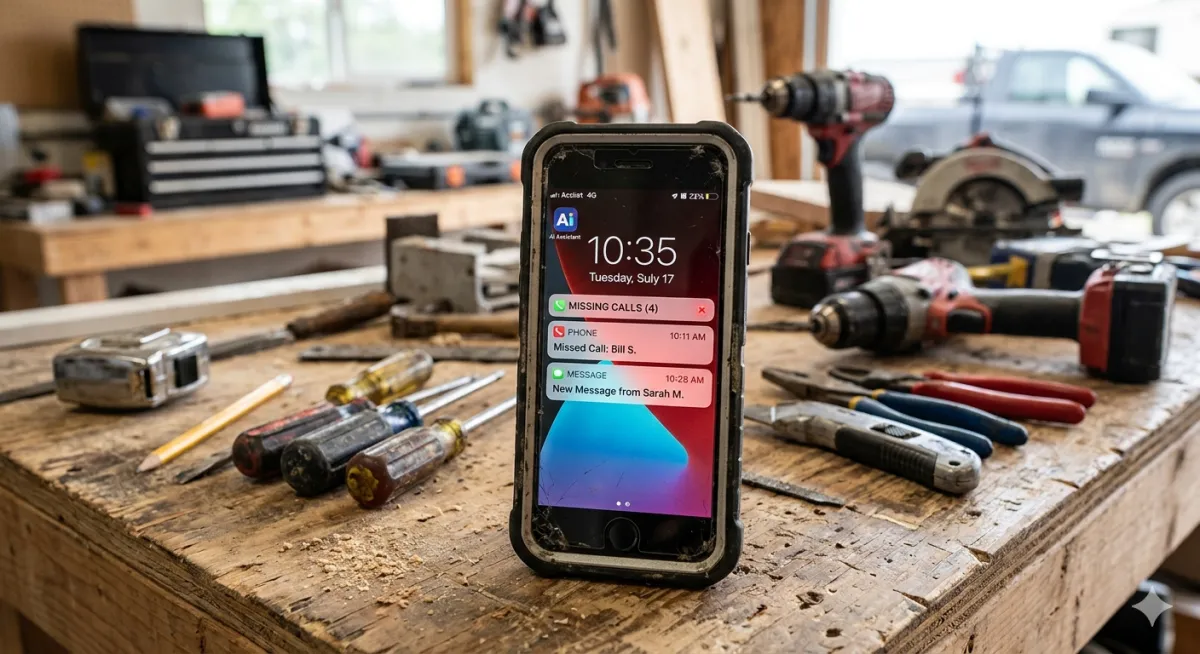
A homeowner's roof starts leaking on a Thursday night. They Google "roofing contractor near me," find three options, and send inquiry forms to all three. By Friday morning, whoever responded first — even with an automated text — is already 70% of the way to winning that job. The other two are still on their to-do list.
This isn't a hypothetical. Research from contractor-focused platforms consistently shows that missing a call results in an 85% chance the customer calls a competitor next. The contractor who responds within five minutes wins the job more often than not. The one who responds the next morning is usually pitching for second place.
AI-powered chatbots, SMS agents, and automated qualification tools exist specifically to close this gap. They're not futuristic — they're deployed by home service businesses right now, at every revenue level. But like any tool, they work when used correctly and waste money when they don't.
Here's what's actually working for contractors in 2026, what to build first, and what to watch out for.
Why AI Qualification Is Different From a Contact Form
A contact form is passive. It collects information and waits for someone to act on it. An AI chatbot or SMS agent is active — it initiates, qualifies, and books in real time, without anyone on your team touching it.
The practical difference: a homeowner who fills out a form at 9 PM gets a call back tomorrow morning, maybe. A homeowner who gets an immediate SMS response — "Thanks for reaching out, I have a few quick questions so we can get you taken care of" — is in a conversation tonight. Companies using AI lead generation chatbots are seeing conversion rates 2–4 times higher than static contact forms.
That gap exists because the form-to-callback model assumes leads will wait. Most won't.
The Four Workflows That Move the Needle for Contractors
Not all automation has equal ROI. Based on what works across home service businesses, these four workflows produce measurable results and are worth building in order:
1. Instant Response to Missed Calls and Web Form Submissions
The single highest-ROI automation for most contractors is the simplest: an immediate SMS when someone calls and you don't pick up, or when someone fills out a form on your website.
The message doesn't need to be sophisticated. "Hey [Name], got your message — we'll call you back within 2 hours. In the meantime, here's a link to see our availability: [link]" outperforms silence by a wide margin. This alone — deployed in a single afternoon — will recover leads that are currently going cold overnight.
2. Conversational Lead Qualification
Once you have instant response working, the next layer is qualification. An AI agent — via website chat or SMS — can ask the questions your office staff would ask: What service do you need? What's your address? Is this urgent or planned? What's your timeframe?
This does two things simultaneously: it keeps the lead engaged while your team is unavailable, and it delivers a pre-qualified, contextualized lead to your team instead of a raw name and phone number. AI agents that adapt their questioning based on context — rather than following a fixed script — produce approximately 40% better qualified leads than rule-based chatbots. The difference matters: a qualification conversation that responds to what the homeowner actually says converts better than one that plows through predetermined questions regardless of the answers.
3. Automated Follow-Up for Unconverted Leads
Most contractors send one follow-up. Most leads need three. An automated sequence — Day 1, Day 3, Day 7 — via SMS and email reaches unconverted leads at the moments when they're most likely to re-engage, without anyone on your team having to track and remember who needs a nudge.
This is where significant revenue gets recovered. A contractor sending 20 estimates per week with a 30% close rate who lifts that rate to 38% through consistent follow-up — without spending a dollar more on advertising — is recovering real pipeline from work that was already done.
4. Post-Job Review Requests
Automating review requests after completed jobs dramatically improves review volume — and review volume directly affects your Google Maps ranking, which affects how many people find you in the first place. The timing matters: a review request sent a few hours after the invoice is paid, when the customer is still in a positive frame of mind, converts at significantly higher rates than a request sent days later or triggered manually when someone remembers.
Build this fourth, not first — but don't skip it. The compounding effect on local SEO is one of the highest long-term ROIs available to any home service business.
What to Actually Build First: A Realistic Sequence
The most common mistake is trying to build everything at once. Here's a practical sequence:
Week 1: Missed call text-back and web form auto-response. One afternoon of setup. Measurable results within the first week.
Week 2–3: Website chatbot for after-hours lead capture and basic qualification.
Month 2: Three-touch follow-up sequence for unconverted leads (Day 1, Day 3, Day 7).
Month 3+: Post-job review automation. Then lead scoring and routing as volume grows.
Track one metric at each stage: contact-to-book rate. That's your north star — not the number of automations you've deployed.
The Honest Warnings
AI qualification tools work. They also create specific failure modes that are worth knowing before you build:
Robotic messaging kills trust faster than silence. If your chatbot sounds like a form letter, homeowners disengage immediately. Conversational tone, first-name personalization, and clear human-handoff points are not optional. The goal is to feel like a responsive business, not an autoresponder.
Bad qualification criteria create a new problem. If your AI is sending every inquiry to your sales team without filtering — including tire-kickers, out-of-area leads, and requests you don't handle — you've added noise without reducing work. Define what a qualified lead looks like for your specific business before you configure the qualification logic.
SMS compliance is not optional. Automated text messages require proper opt-in consent. This isn't a technicality — non-compliance carries real financial exposure. Work with a platform that builds TCPA compliance into the workflow, not one that leaves it to you to figure out.
Always build a human escape hatch. When a customer is frustrated, asking a complex question, or clearly ready to book, your system needs to route them to a real person immediately. Some customers simply don't want to interact with AI, and forcing the conversation through automation at that point loses the job. The best implementations use AI for the consistency layer and humans for the judgment layer — and make the handoff seamless.
If You're Already Running Jobber or Housecall Pro
A common misconception: that building AI qualification means replacing your field management software. It doesn't.
Jobber and Housecall Pro are excellent at what they're built for — scheduling, dispatch, invoicing, job management. What they don't do natively is the revenue-generating layer: instant multi-channel response to new inquiries, automated follow-up sequences, post-job review requests triggered the moment a payment clears. That layer connects to your existing platform — it doesn't replace it. Your team keeps working exactly as they do today.
The integration approach that works: your field software handles the job. An automation layer connected to it handles everything that happens before the job, between jobs, and after jobs.
The Bottom Line
The contractors winning on lead conversion in 2026 aren't necessarily the best at the trade. They're the fastest and most consistent at follow-up. AI qualification tools are how you achieve that speed and consistency without adding headcount or requiring your team to be available 24 hours a day.
Start with one workflow. Measure it. Build from there. The businesses that move first get a compounding advantage — more reviews, better Google rankings, more leads, better follow-up — that gets harder for competitors to close every month it runs.
Ready to See Where Your Lead Flow Is Leaking?
A Revenue Audit is 45 minutes. We map your current lead capture, qualification, and follow-up process, find the specific gaps, and show you which automations move the needle first for your business. The blueprint is yours to keep.
45 minutes. No obligation. Blueprint is yours to keep.
