The AI-First Contractor: How Small Home Service Firms Are Out-Competing the Big Guys
Big franchises used to win on systems. Now you can have better systems—and still have the relationship advantage they
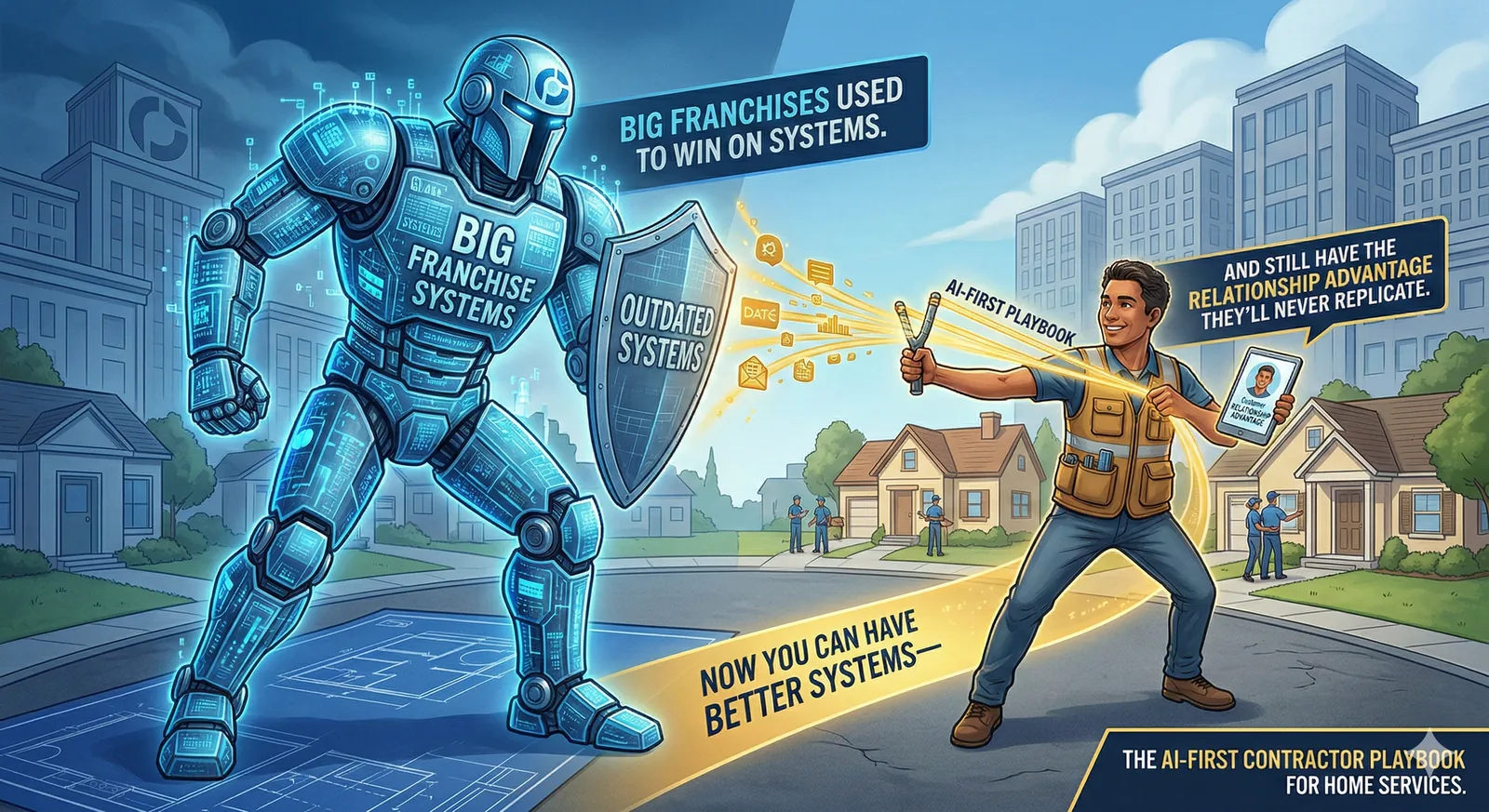
For decades, the big players in home services had one insurmountable advantage: infrastructure. Large HVAC companies, national plumbing franchises, and regional landscaping chains could afford the dispatch software, the CRM systems, the marketing budgets, and the office staff that small operators couldn't touch.
If you ran a three-truck plumbing operation or a five-crew landscaping company, you competed on hustle, reputation, and relationships—because you couldn't compete on systems.
That's changing fast. And the contractors who see it first are going to win big.
The Old Playbook Is Breaking Down
The big guys built their advantage on process. Standardized estimates. Automated follow-ups. Professional invoicing. Real-time scheduling. A customer experience that felt polished and reliable, even if the actual work was no better than what the local guy down the street could do.
Small operators had the craftsmanship. The big companies had the machine.
But here's the thing about machines: they're only an advantage until everyone can afford one.
AI is rapidly democratizing the operational infrastructure that used to require a team of people and a five-figure software stack. Scheduling, customer communication, estimating, job costing, follow-up sequences, marketing copy, reputation management—tasks that once required dedicated staff are now within reach of a one-person office running lean.
The small contractor who embraces this doesn't just close the gap with the big guys. In many cases, they leapfrog them.
Where Small Operators Actually Have the Edge
Before we get into how AI helps, it's worth naming something the playbooks rarely acknowledge: small home service firms have structural advantages that large companies can't replicate.
Speed of decision-making. A regional franchise needs approval chains to change pricing, update a service offering, or try a new approach with customers. A small operator can decide and act today.
Real relationships. The owner of a small firm often knows customers by name, remembers their dog's name, and shows up personally when something goes wrong. That kind of trust is nearly impossible to scale—and customers pay for it.
Local reputation. A single five-star review means more for a 10-person operation than it does for a company with 500 employees. Word-of-mouth still drives home services, and small firms are better positioned to earn it.
Flexibility. Small operators can serve niche markets, say yes to unusual jobs, and pivot faster than large companies stuck in standardized service menus.
These advantages are real. The problem has always been that they get overwhelmed by operational drag—the paperwork, the follow-ups, the admin, the estimating—that consumes the owner's time and keeps the business from scaling.
AI attacks that drag directly.
What AI-First Actually Means in Practice
"AI-first" doesn't mean replacing your crew with robots or turning your business into a tech startup. It means building your operation so that AI handles the repetitive, time-consuming work—so you and your team can focus on the parts that actually require a human.
Here's what that looks like in a real home service business:
Customer communication, on autopilot. AI can handle appointment confirmations, follow-up messages after a job, review requests, and re-engagement sequences for past customers—without anyone in your office lifting a finger. The message feels personal. The effort is zero.
Estimates that take minutes, not hours. With the right tools, AI can help generate detailed, professional estimates based on job parameters, your historical pricing, and regional material costs. What used to take an owner two hours of back-and-forth can happen before the customer finishes their coffee.
Job notes and documentation from the field. Crews can describe what they did, what materials they used, and any issues they found—by voice or a quick phone entry—and AI turns it into clean documentation, job cost records, and invoice line items. No more lost notepads. No more end-of-day data entry marathons.
Marketing content that doesn't require a copywriter. Service pages, seasonal promotions, email newsletters, social posts—AI can produce a first draft in seconds. A small operator can now maintain a professional, consistent marketing presence that would have required an agency retainer three years ago.
Smarter scheduling and routing. AI-assisted dispatch tools help small operators optimize crew routes, reduce windshield time, and pack more jobs into a day without burning out their people.
None of this requires a tech background. The tools are getting simpler every month. What it requires is the willingness to build new habits—and to stop accepting operational drag as "just part of the job."
The Franchise Killer: Agility Plus Infrastructure
Here's the competitive scenario that should excite every small operator reading this.
A national franchise competing in your market has:
Standardized pricing that doesn't account for local nuance
Customer service routed through a call center
Slow-moving marketing controlled at the corporate level
Middle management layers that slow down every decision
You, running an AI-assisted operation, have:
Instant, professional customer communication
Estimates out the door same day
Job costing that tells you exactly where you're making money
Marketing that speaks to your specific market
The personal touch the franchise can never replicate
The franchise used to win because they had systems. Now you have systems too—and you still have the relationship advantage they'll never have.
That's a different competitive equation than the one small contractors have been fighting for the last 20 years.
The Window Is Open—But It Won't Stay That Way
Here's the honest truth about this moment: it's early.
Most small home service operators are still running the same way they were five years ago. The contractors who move now—who start replacing manual admin with AI-assisted workflows, who build the communication and documentation habits that compound over time—are going to build a durable competitive advantage before the rest of the market catches up.
The big guys will eventually figure this out, too. National franchises will invest in AI tools. The technology will get commoditized. The edge will narrow.
But right now, the small operator who runs lean, moves fast, and builds smart is in the best competitive position they've been in a generation.
Where to Start
You don't have to overhaul your entire operation overnight. The contractors who win with AI aren't the ones who buy every tool at once—they're the ones who pick one painful process, fix it, and build from there.
A few good starting points:
Fix your follow-up first. Missed follow-ups are one of the highest-leverage losses in home services. An automated sequence that checks in after an estimate, confirms an appointment, and requests a review after job completion can add revenue immediately with almost no ongoing effort.
Get your job costing right. You can't price better until you know where you're actually losing money. Start capturing real labor and material data from the field, and let AI help you make sense of it.
Let AI write your first draft. Whether it's a service page, a customer email, or a seasonal promotion—stop staring at a blank screen. Give AI a prompt, edit the output, and publish. You'll produce more content in a month than most competitors do in a year.
The goal isn't to become a tech company. It's to run a better contracting business—one where your time goes to the work that actually matters, your customers feel well taken care of, and the profit at the end of the month actually reflects the effort you put in.
That's what AI-first looks like in home services. Let AI be your towel, just about the most massively useful thing an intergalactic contractor can have. And the contractors building it right now are the ones who'll be hardest to compete with in three years.
Massively Useful helps small home service businesses find and implement the AI tools that actually move the needle—without the overwhelm. We also offer outsourced human agents so you can provide that personal interaction without blowing out your costs. If you're ready to stop paying the paperwork tax and start building a leaner operation, we can help.