


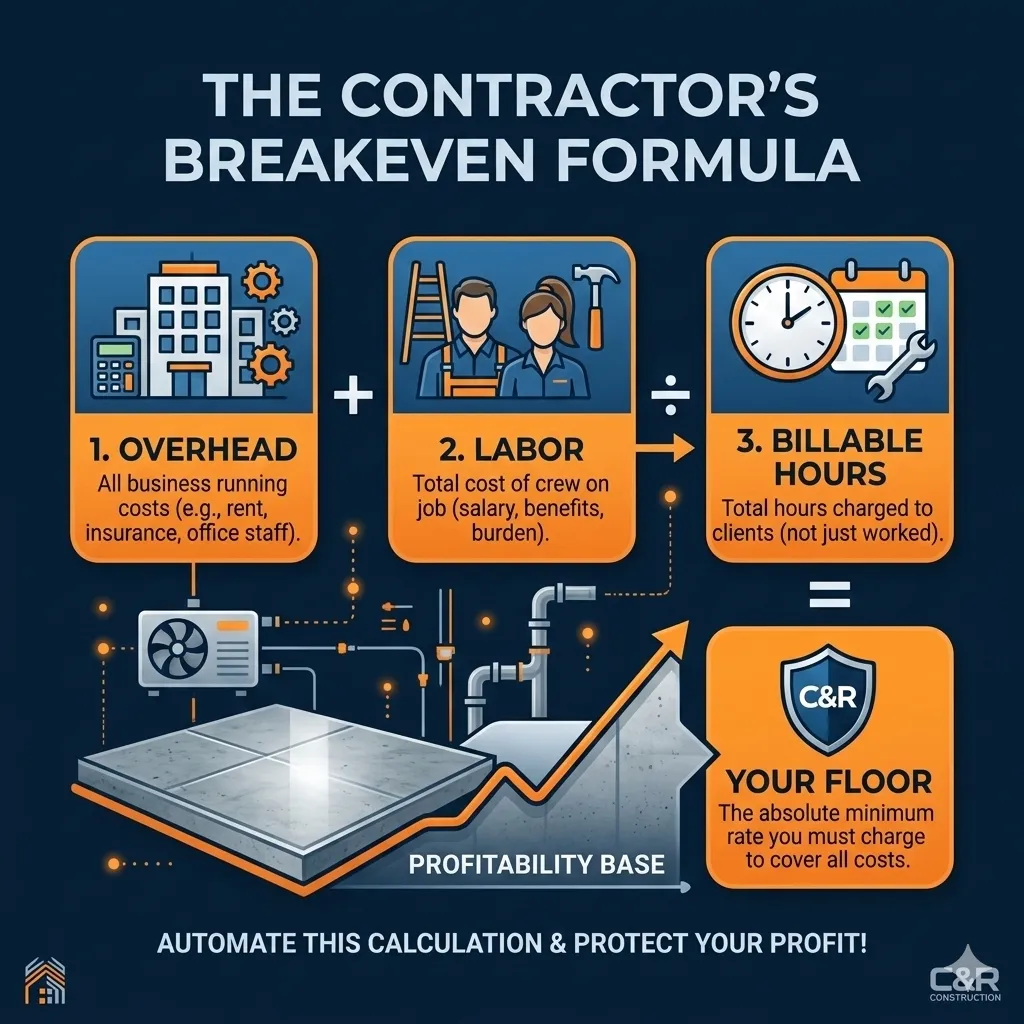
Why Most Contractors Are Pricing Their Services Wrong — And How to Fix It Before Your Next Quote
A contractor we spoke with recently told us he'd been charging $95/hour for six years. Business was good — his schedule was full, customers were happy, he was staying busy.
Then he ran the numbers. His actual cost per billable hour, once you factored in his trucks, insurance, payroll taxes, workers' comp, software, and his own time, was $112.
He had been losing $17 on almost every hour worked for six years.
Full schedule. Busy season. Negative margin.
If it weren't for margins on parts and fees, he'd be out of business already. He's not unusual. In our experience working with home service businesses across the country, most owners have never calculated their true breakeven rate — and nearly all of them are underpricing as a result. They're not bad business people. They're just working without the right number in front of them.
This post gives you that number and explains how to use it.
The Fundamental Mistake: Pricing Based on the Market Instead of Your Costs
It feels logical to price based on what competitors charge. If every other HVAC tech in your area bills $120/hour, you charge $115 to be competitive, or $125 to signal quality. That's market-based pricing — and it works fine, as long as your costs happen to be lower than the market rate.
The problem: you have no idea if they are.
Your competitor might own their trucks outright and carry no debt. They might have cheaper insurance because they've been in business longer. They might pay their guys less, or run leaner on marketing. Or — and this is common — they might be losing money too and just don't know it yet.
Pricing off the market is, at best, an educated guess. What you need is a floor: the minimum you can charge per billable hour and still cover all costs while hitting a real profit margin. That's your breakeven rate. Everything above it is the actual margin. Everything below it is a slow leak.
The Massively Useful take: Your breakeven rate is the most important number in your business that most owners have never calculated. It takes about 3 minutes to find it. We built a free tool to help...try the Contractor Breakeven Calculator here.
What Actually Goes Into Your Real Hourly Cost
Most contractors, when they think about their costs, think about the obvious stuff: wages, maybe fuel, maybe insurance. But the full picture has a lot more line items than that — and the ones people miss are often the biggest margin killers.
Fixed Overhead (The Costs That Run Whether You Work or Not)
These are the expenses your business pays every single month, regardless of how many jobs you complete:
Vehicle payments, insurance, registration, and fuel
Tools, equipment maintenance, and replacement
General liability insurance and workers' comp
Licensing, bonds, and permits (amortized monthly)
Software — your CRM, scheduling platform, accounting, and job management
Marketing and advertising — Google Ads, Angi, your website, SEO
Phone, internet, and utilities
Office or admin support
Rent or storage
Add those up for your business right now. Most contractors are surprised by how quickly it climbs. A typical 3-person home service operation runs $5,000–$10,000/month in fixed overhead before a single person gets paid.
Labor Cost (The Full Number, Not Just Wages)
This is where most owners dramatically underestimate their costs. Your labor cost isn't just what you pay your crew — it's everything attached to it:
Gross wages for all employees
Your own pay — either a wage or an owner's draw at market rate (this one is critical; if you're not paying yourself, you're not actually accounting for your own cost)
Employer payroll taxes (Social Security, Medicare, FUTA/SUTA — typically 9–12% of gross wages)
Workers' compensation insurance (varies by trade, typically 4–8% of wages)
Health benefits and PTO accrual
When you add labor burden on top of base wages, the true cost of an employee is typically18–25% higher than their paycheck alone. Most owners price off the paycheck number, not the true number.
67% of home service owners have never calculated their true breakeven rate
18–25% labor burden on top of wages that most owners don't factor into pricing
60–75% typical billable efficiency rate once drive time and admin are accounted for
The Hidden Multiplier: Billable Efficiency
Here's the part of the equation most contractors never think about at all. Your team doesn't bill 8 hours for every 8 hours they're on the clock. There's drive time between jobs, callbacks, lunch, admin, picking up materials, and the occasional job that runs long and can't be billed in full.
In practice, most home service businesses run a billable efficiency rate of 60–75%. That means a tech who clocks 8 hours actually produces 4.8–6 billable hours.
If you're calculating your cost per hour based on clock hours, you're dividing by a number that's 25–40% too large — which means your estimated cost per billable hour is significantly lower than reality.
True Hourly Cost = (Monthly Overhead + Monthly Labor) ÷ Billable Hours
Breakeven Rate = True Hourly Cost ÷ (1 − Desired Profit Margin)
That's the math. Simple in theory — most owners just never sit down and run it with accurate numbers.
Running the Numbers: A Real Example
Let's put this together for a hypothetical 3-person landscaping and lawn care operation:
Now let's figure out billable hours. Three technicians, 22 working days, 8 hours per day, at a 70% billable efficiency rate:
3 techs × 22 days × 8 hrs × 70% = 369 billable hours/month
True hourly cost: $27,900 ÷ 369 = $75.61/hr
At a 20% net profit margin target:
$75.61 ÷ (1 − 0.20) = $94.51/hr target rate
If this business is charging $85/hour because "that's what the market charges," they're covering costs but leaving $9.51/hr — over $42,000/year — on the table. If they're charging $75, they're running at breakeven with no cushion for a slow month, equipment breakdown, or growth investment. If they're charging $65, they're losing money on every job.
The target rate isn't a suggestion. It's the floor.
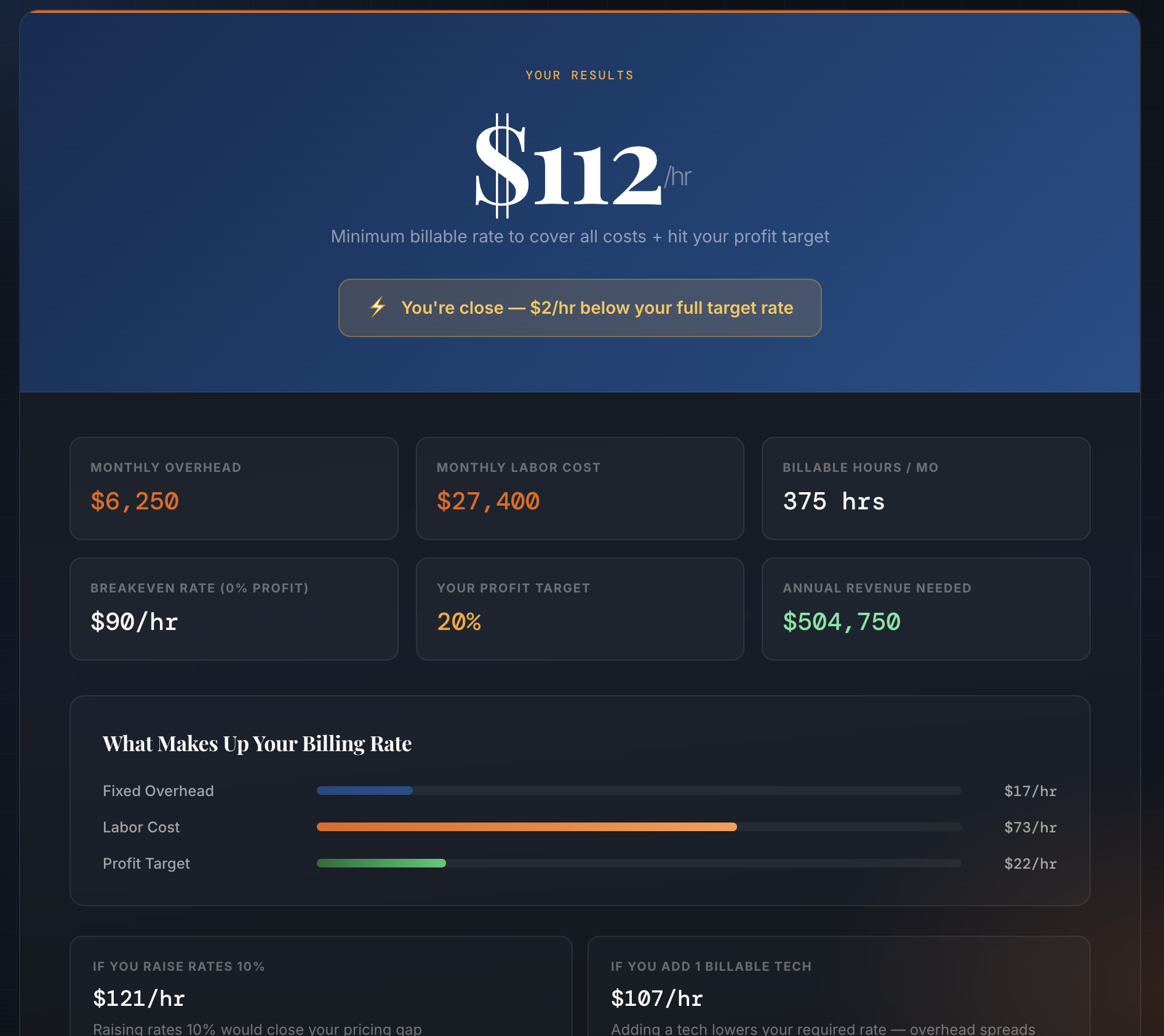
Try it with your numbers: Our free Contractor Breakeven Calculatorwalks you through every cost category, auto-calculates your labor burden, and outputs your target hourly rate — along with what-if scenarios for raising rates, adding a tech, or cutting overhead. It takes about 3 minutes.
What to Do Once You Know Your Breakeven Rate
Scenario 1: You're Already Charging Above It
Great — but don't stop there. Calculate exactly how much margin you're running on a per-hour basis. That number tells you how much room you have to invest in growth, absorb slow months, or compete on price for strategic jobs without bleeding cash. Knowing your margin isn't just reassuring; it's a planning tool.
Scenario 2: You're Charging Right at Breakeven
This is the most dangerous position in business. You look profitable — the jobs are paying the bills — but you have no cushion. One bad month, one truck repair, one worker's comp claim, and you're in the red. You need to raise rates, reduce costs, or increase billable hours. Probably all three, incrementally.
Scenario 3: You're Charging Below Your Breakeven Rate
Don't panic — but do act. A few things to consider:
You don't have to raise rates overnight. A 10–15% increase phased in over two or three months is often less disruptive than owners expect. Most customers who value your work will stay.
New customers get your new rates immediately. You're not obligated to grandfather everyone indefinitely.
Look at efficiency before rates. Sometimes the gap closes faster by improving your billable efficiency rate — tighter routing, fewer callbacks, better job scoping — than by raising what you charge.
Have the conversation with your accountant.A breakeven rate calculation is a starting point; your tax situation, depreciation schedule, and cash reserves add nuance that a calculator can't fully capture.
The Problem with "What the Market Charges" Pricing (Revisited)
We keep coming back to this because it's the most common mistake we see. Here's the thing about market-rate pricing: it works as a sanity check, not as a foundation.
If your breakeven rate is $94/hr and the market rate in your area is $120/hr, you have $26/hr of runway — and you know it. You can compete aggressively, run promotions, or price premium without guessing.
If your breakeven rate is $94/hr and the market rate is $85/hr, you have a real problem — and now you can address it deliberately instead of discovering it when you can't make payroll.
Market rate is useful data. Your breakeven rate is the anchor. You need both numbers.
Beyond Hourly: How Your Breakeven Rate Translates to Project and Flat-Rate Pricing
Most home service jobs aren't billed purely by the hour — you're quoting projects, flat-rate service calls, or bundled packages. Your breakeven rate still does the work; you just apply it differently.
For a project bid: estimate total labor hours, multiply by your target rate, add materials at your margin, and that's your floor. For flat-rate pricing: build your price book using your target rate as the labor input. For service agreements or maintenance contracts: calculate the expected labor hours across the contract period and price accordingly.
Whatever pricing model you use, the underlying hourly rate is the engine. If it's wrong, everything downstream is wrong.
🧮 Free Tool: Contractor Breakeven Rate Calculator
We built a free calculator specifically for home service contractors that walks through every cost category — overhead, labor burden, billable efficiency — and outputs your minimum target rate, what you're leaving on the table, and four what-if scenarios.
→ Run your numbers free at massivelyuseful.ai
It takes about 3 minutes and you'll have a number you can use on your next quote.
The Bottom Line for Home Service Pros
Pricing is not a feeling. It's not what the guy down the street charges. It's not what customers seem willing to pay. It's a math problem — and once you do the math, you stop guessing and start building a business that actually makes money on every job, not just the busy seasons.
The contractor who's been at $95/hour for six years? He raised his rates to $115 this year. He lost two customers. He's working fewer hours for more money, and for the first time, his books make sense.
That starts with one number. Go find yours.
Know Your Floor. Build Above It.
Your breakeven rate is the start, not the finish. A Massively Useful Revenue Audit maps your entire lead-to-cash flow — pricing, lead capture, follow-up, and the systems that tie them together — and gives you a blueprint to build profitable, predictable revenue above your floor.
45 minutes. No obligation. Blueprint is yours to keep.
